Leg Press
The leg press is a machine exercise where you sit or recline and push a weighted platform away with your feet. Your quads do most of the work, and your glutes and hamstrings help more as you go deeper. Because the machine controls the path, you can train your legs hard without balancing a bar. That makes it useful for beginners who are still building leg strength, and for experienced lifters adding leg volume after squats.
Squats load your spine and ask your whole body to stay upright, so your back or balance can limit you before your legs do. On a leg press, your torso is supported and your legs become the limiting factor, so you can push close to failure more safely. You lose the balance and core work of a squat, and the numbers on the sled are not comparable to what you squat. Foot position is easy to change, which lets you shift the emphasis during a session.
Muscles worked
- Quads (primary)
- Glutes
Equipment
Machine
How to do it
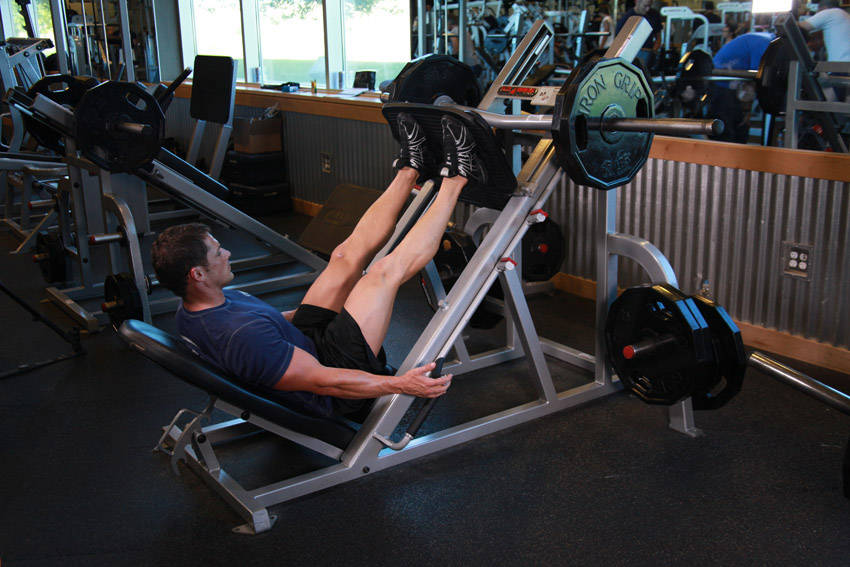
- Sit in the machine with your back and hips flat against the pad. Place your feet on the platform about shoulder width apart, toes turned out slightly.
- Press the platform up until your legs are nearly straight, then release the safety handles and hold the side grips.
- Take a breath and brace your abs. Keep your head, back and hips pressed against the seat.
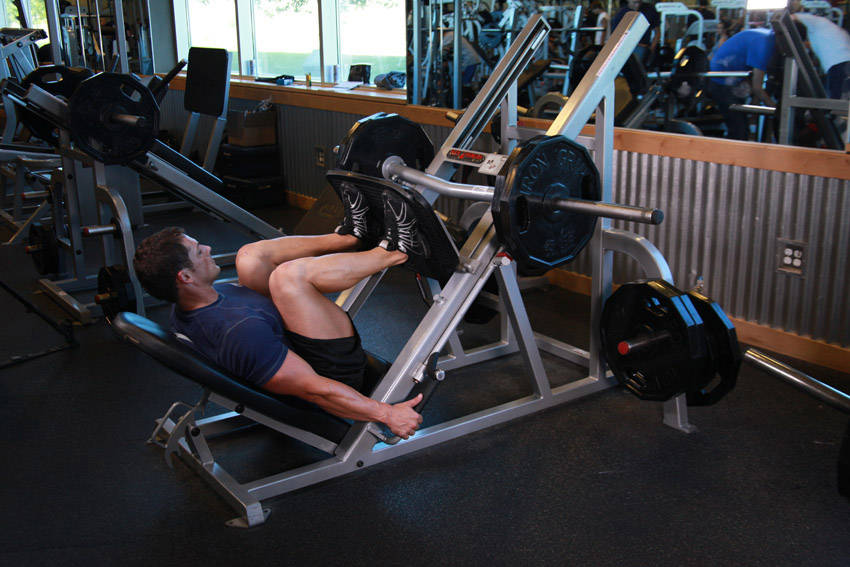
- Lower the platform slowly by bending your knees and hips, letting your knees track in line with your toes.
- Go as deep as you can while your lower back stays flat on the pad, usually with your knees reaching about 90 degrees or a bit more.
- Push through your whole foot, keeping your heels down, and press the platform away without letting your knees cave in.
- Stop just short of full knee lockout. After your last rep, lock the safety handles before you take your feet off the platform.
Common mistakes
- Letting your hips lift off the seat. Going too deep can roll your pelvis up and round your lower back. Stop the descent just before this happens, and adjust your depth or the seat.
- Snapping your knees straight. A hard lockout under a heavy load puts the stress on your joints instead of your muscles. Finish each rep with a slight bend, under control.
- Doing tiny reps with a huge stack. Piling on plates for a few inches of movement looks impressive and does little. Take weight off until your knees reach at least 90 degrees.
- Letting your knees collapse inward. Knees that drop in on the way up waste force. Press your knees out gently so they follow your toes.
- Pushing with your hands. Pressing on your knees with your hands takes work away from your legs. Keep your hands on the grips and lower the load if you need the help.
Variations
- Single-leg press : Work one leg at a time to fix an imbalance or to get more out of a machine with limited weight.
- Vertical leg press : Lie with the platform directly above you for a deep bend at the hips when your gym has this machine.
- Hack squat : Move to this machine for a more upright, quad-focused option that feels closer to a squat.
- High or low foot placement : Set your feet high on the platform for more glutes and hamstrings, or lower for more quads, provided your heels stay down.
Sets and reps to start with
For leg size, do 3 to 4 sets of 8 to 15 reps with 2 minutes of rest, stopping a rep or two short of failure. Since the machine supports you, you can also do a set of 15 to 20 to finish a workout. For strength, 4 sets of 6 to 10 reps works well. Beginners can start with 3 sets of 12 and a load that lets them hold a full range. Leg press once or twice a week, either as your main lift or after squats. Add weight when you hit the top of your range at full depth, and compare your numbers only on the same machine, since sled angles and the weight of the sled differ.
Frequently asked questions
Is the leg press as good as squats?
It can build your legs just as well, but it trains less of your body. Squats add core, back and balance work, while the leg press focuses on your legs alone. For muscle size, many lifters get great results from both, and either can lead if the other does not suit you.
Where should you place your feet on a leg press?
Start in the middle of the platform at about shoulder width. A higher placement shifts more work to your glutes and hamstrings, and a lower placement shifts more to your quads. A wider stance brings in your adductors. Your heels should stay down in any position.
How deep should you go on the leg press?
Go as deep as you can while your lower back and hips stay against the pad. For most people that means about 90 degrees at the knee, or deeper. If your hips start to curl up off the seat, you have gone too far.
Why should you not lock your knees on the leg press?
Snapping your knees straight under a heavy load shifts the weight from your muscles to your joints, and it takes the tension off your quads. Keep a slight bend at the top of each rep. It also makes the set harder, which is the point.
Does the weight on the leg press count the same as a squat?
No, the two numbers are not comparable. On an angled sled, you push only part of the load, and machines differ in angle and sled weight. Measure your progress against your own past sessions on the same machine.
See the 28 machines for this movement →
Similar exercises
Log your leg press and see the weight to try at every workout. Free, no ads.