Lat Pulldown
The lat pulldown is a seated cable exercise where you pull a bar from overhead down to your upper chest. Your lats are the main target, and your biceps, rear delts and mid-back muscles assist. It suits nearly everyone: beginners who cannot do a pull-up yet, lifters who want a wider-looking back, and anyone who wants to add back volume without worrying about their grip or body weight.
A pull-up has you moving your body under a fixed bar, and you need to be fairly strong to do even one. The pulldown lets you choose the load, so you can do clean sets at 8, 12 or 15 reps and raise the weight in small steps. It is also easy to change the handle. You do miss out on some of the core and grip work of a pull-up, and a thigh pad is doing some of the stabilizing for you, but that also lets you focus on your back.
Muscles worked
- Lats (primary)
Equipment
Machine, Cables
How to do it
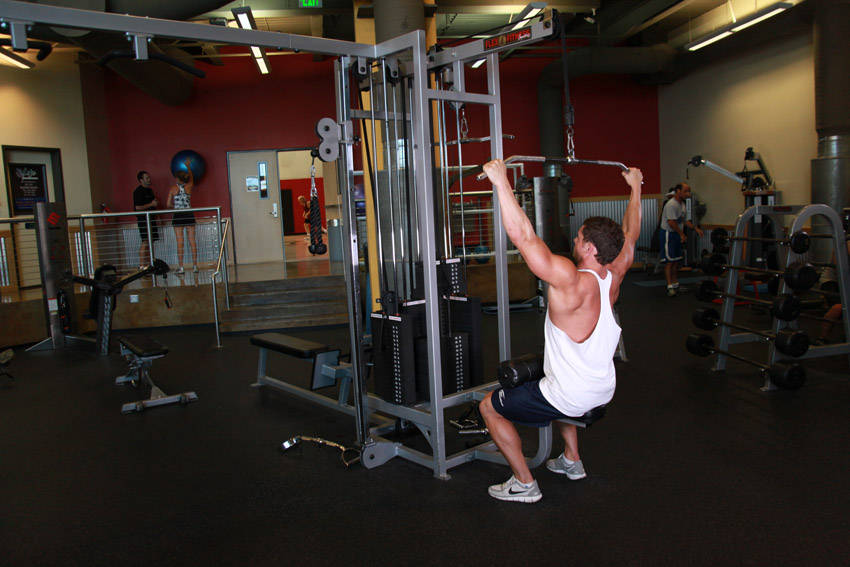
- Sit facing the machine and adjust the thigh pad so it holds your legs down snugly, with your feet flat on the floor.
- Stand up to grab the bar with an overhand grip a little wider than your shoulders, then sit down, letting the bar pull your arms straight above you.
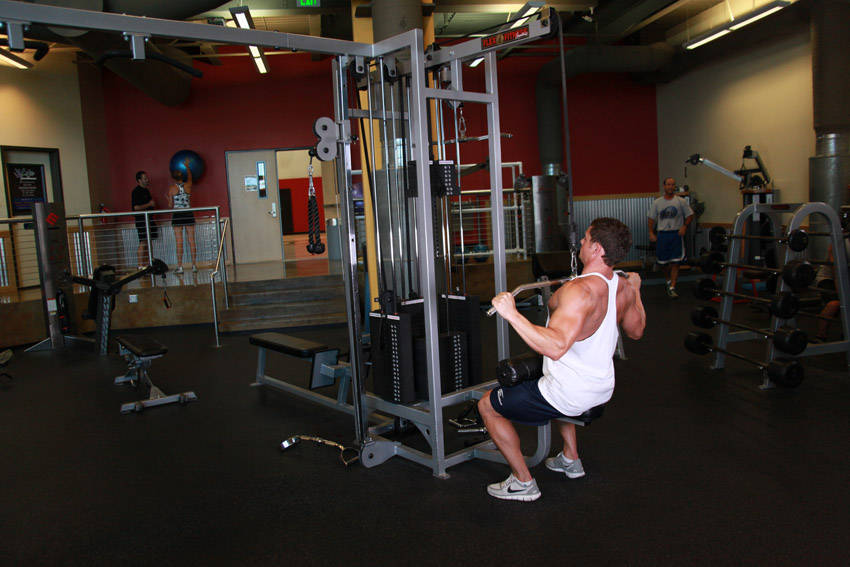
- Lean back slightly from your hips, around 10 to 15 degrees, and lift your chest. Keep this angle for the entire set.
- Begin the pull by bringing your shoulders down, away from your ears, while your arms stay long.
- Drive your elbows down toward your ribs and bring the bar to your upper chest, around your collarbone. Keep your chest up to meet the bar.
- Pause briefly with your lats squeezed, then let the bar rise slowly until your arms are straight and you feel a stretch under your armpits.
Common mistakes
- Leaning way back. A big lean turns the pulldown into a row and lets momentum help. Stay within a small lean and hold it, and reduce the load if your torso starts to swing.
- Pulling with your hands. Thinking about your hands makes your biceps take over. Think about your elbows driving down instead, and treat your hands as hooks.
- Shrugging at the top. Staying loose at the stretch is fine, but starting the pull with raised shoulders robs your lats. Bring your shoulders down first.
- Cutting the stretch short. Stopping with your arms bent saves energy and costs you range. Let your arms straighten on each rep before you pull again.
Variations
- Close-grip lat pulldown : Use a V-bar or neutral handles when you want a longer range and a stronger pull with your elbows close to your body.
- Wide-grip lat pulldown : Take a grip well outside your shoulders if you like the feeling in your upper lats, knowing the range gets shorter.
- Single-arm lat pulldown : Use one handle to work each side alone and get a deeper stretch at the top.
- Underhand lat pulldown : Turn your palms toward you for more biceps involvement, similar to a chin-up.
Sets and reps to start with
For back size, do 3 to 4 sets of 8 to 12 reps with 60 to 90 seconds of rest, stopping one or two reps short of failure. For strength or to build toward pull-ups, use 4 sets of 6 to 8 with a heavier stack and a bit more rest. Beginners can start with 3 sets of 10 to 12 and a load that allows a pause at the chest. Train it once or twice a week, paired with a row such as the seated cable row. Weight stacks vary between gyms, so compare your numbers only on the same machine. Add a plate when you hit the top of your reps without your torso moving.
Frequently asked questions
What muscles does the lat pulldown work?
It trains your lats most, with your biceps, rear delts, middle traps and rhomboids assisting. Your forearms work to hold the bar. Grip width and hand position change the balance a little, but your lats stay the main target.
Is a wide grip better than a close grip for lat pulldowns?
Neither is clearly better for your lats. A moderate grip a little wider than your shoulders is a good default, while a very wide grip shortens the range. Close grips let you pull through a longer range, so choosing the one you feel the most is a fair approach.
Should you lean back during a lat pulldown?
Yes, a small lean of around 10 to 15 degrees is fine because it gives the bar a clear path to your chest. Hold the angle during the set instead of swinging back to start each rep. If you lean much further, the exercise starts to become a row.
Should the bar go behind your neck on a lat pulldown?
Pull to your upper chest instead. Behind-the-neck reps force your shoulders into a position many people find uncomfortable, and they do not offer a clear advantage for your lats. The front version gives you a full range and is the standard choice.
Will lat pulldowns help me do a pull-up?
They help by building the muscles and the pulling pattern, though they will not fully replace practice on the bar. Pair them with negatives and assisted reps. As your pulldown gets closer to your body weight, your pull-up attempts usually start to feel easier.
See the 26 machines for this movement →
Similar exercises
Log your lat pulldown and see the weight to try at every workout. Free, no ads.