Pull-Up
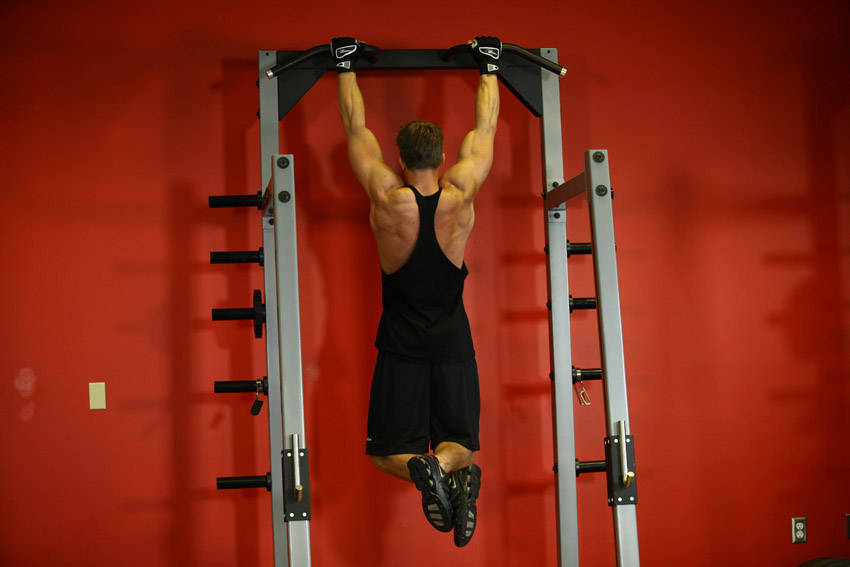
The pull-up is a bodyweight exercise where you hang from a bar with your palms facing away and pull yourself up until your chin clears it. Your lats are the main muscle, your biceps help bend your elbows, and your mid-back, forearms and abs work too. It is one of the best measures of upper body strength relative to your size, and it is a goal for many people who cannot yet do a single rep.
A lat pulldown trains the same pattern, but it lets you pick any load and sit in a stable seat. On a pull-up, you move your whole body through space, so your grip and core have to work and the exercise gets harder as your body weight goes up. Chin-ups use an underhand grip and usually feel easier because your biceps have a better angle. All you need is a bar, and once you outgrow your body weight, you can add a belt with plates.

Muscles worked
- Lats (primary)
- Biceps
Equipment
Bodyweight
How to do it
- Grip the bar with your palms facing away, a little wider than your shoulders, and hang with your arms straight. Wrap your thumbs around the bar.
- Pull your shoulders down and slightly back so you are not sagging into your joints. Tighten your abs and glutes, and keep your legs fairly straight or lightly crossed.
- Start the pull by driving your elbows down toward your ribs, as if you were trying to put them in your back pockets.
- Keep your chest up and lean back slightly as you rise, so your body moves up in a smooth line without kicking.
- Continue until your chin is clearly over the bar and your upper chest is close to it. Pause for a moment.
- Lower yourself slowly over two or three seconds until your arms are straight and your shoulders are under control, then start the next rep without swinging.
Common mistakes
- Doing half reps. Stopping halfway down or below the bar makes your numbers look better than your strength. Go to straight arms at the bottom and chin over the bar at the top.
- Kicking and swinging. Using your legs for momentum moves work away from your back. Squeeze your glutes and keep your legs still, and use an assisted version if you need help.
- Craning your chin up. Pushing your neck forward to reach the bar is not a real rep. Keep your neck neutral and bring your chest toward the bar.
- Dropping down fast. A free fall wastes the part of the rep that builds strength. Control the way down every time.
Variations
- Assisted pull-up : Use a machine or a band if you cannot do full reps yet, or to add more volume after your hard sets.
- Negative pull-up : Jump or step up to the top and lower yourself over several seconds to build the strength for your first rep.
- Chin-up : Turn your palms toward you for more biceps involvement and usually a few more reps.
- Weighted pull-up : Add a dip belt or a weighted vest when you can do around 10 clean reps and want to keep building strength.
Sets and reps to start with
If you cannot do a full rep yet, train 2 to 3 times a week with 3 sets of 3 to 5 slow negatives plus 3 sets of 6 to 10 assisted reps. If you can do a few, do 3 to 5 sets of about half your max reps, with 2 minutes of rest, and add a rep to a set when it feels easy. If you can do 10 or more, add weight and work with 3 to 5 sets of 4 to 8 reps. Stop before your form falls apart, as ugly reps do not add to your total. Two or three weekly sessions give most people steady progress.
Frequently asked questions
How do I get my first pull-up?
Practice the hardest version you can do well. Slow negatives, band-assisted reps and hanging from the bar all build toward it, and lat pulldowns can help too. Train two or three times a week, and if you are carrying extra body weight, losing some of it makes the job easier.
What is the difference between pull-ups and chin-ups?
A pull-up uses an overhand grip with your palms facing away, while a chin-up uses an underhand grip with your palms facing you. Both train your lats and biceps, but chin-ups put your biceps in a stronger position, so most people can do more of them. Neither is better, and it is worth training both.
How many pull-ups should I be able to do?
There is no single standard, and your body weight affects it a lot. Getting your first strict rep is a real milestone, and reaching sets of 10 is a good sign of solid upper body strength. Compare yourself with your own past numbers.
Are pull-ups better than lat pulldowns?
Pull-ups ask more from your grip and core, and they train you to move your own body. Lat pulldowns let you choose the load, so they are better for beginners and for high-rep back work. Use both if you can.
Can you do pull-ups every day?
Most people get better results with a day of rest between hard sessions. Your elbows and shoulders take a lot of load, and your muscles need time to recover. If you do train daily, keep each session easy and stop well short of failure.
Similar exercises
Log your pull-up and see the weight to try at every workout. Free, no ads.