Lateral Raise
The lateral raise is an isolation exercise for your side delts, the part of the shoulder that gives your upper body its width. You stand with dumbbells at your sides and lift your arms out in an arc until they reach about shoulder height. Your upper traps help a little, but the side deltoid should do the work. Almost every physique-focused program includes it, and beginners can start it from day one with a light pair of dumbbells.
Overhead presses mostly load your front delts and triceps, so side delts rarely get enough direct work from pressing alone. This raise goes straight at them. The catch is leverage: with your arm held out long, even a small dumbbell feels heavy, so the weight numbers look humble and ego gets in the way. Cables load the bottom of the movement better, while dumbbells are the simplest way to get started at home or in any gym.
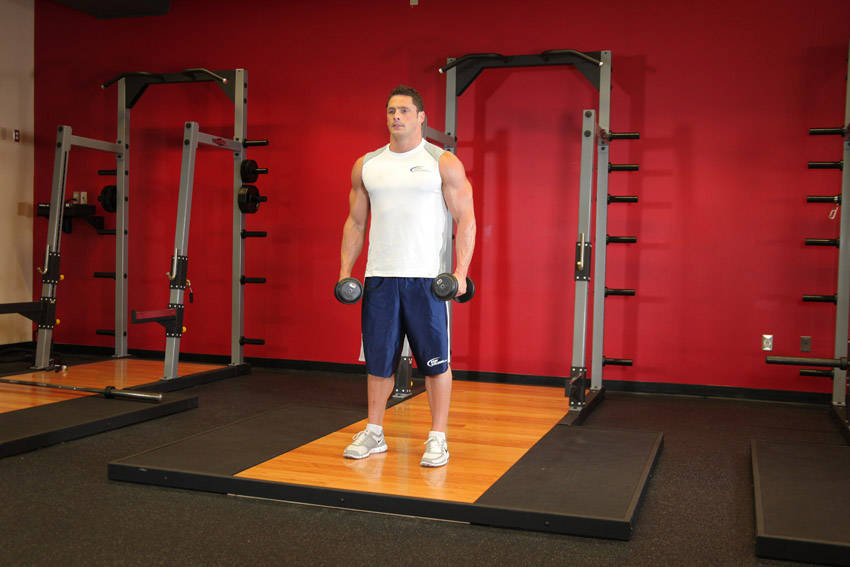
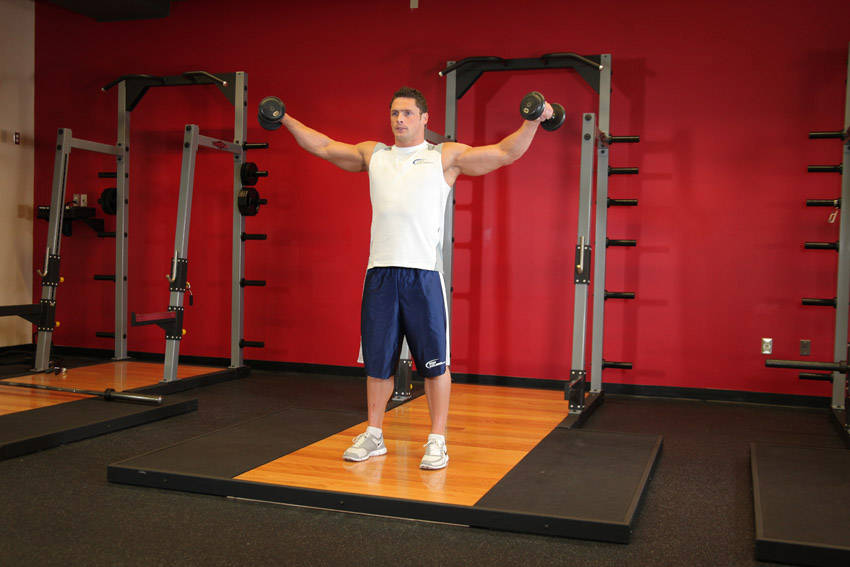
Muscles worked
- Side deltoid (primary)
Equipment
Dumbbells, Cables
How to do it
- Stand tall with a dumbbell in each hand at your sides, palms facing in, and your feet about hip width apart. Bend your knees slightly and brace your abs.
- Bring your arms a little forward of your sides, so they travel in line with your shoulder blades. This angle usually feels smoother than lifting directly sideways.
- Keep a slight bend in your elbows and lock that angle. Keep your shoulders down, away from your ears.
- Lift your arms out and up, leading with your elbows, as if pushing your hands out toward the walls. Your wrists stay straight and in line with your forearms.
- Stop around shoulder height, with your elbows level with or slightly above your hands. Hold for a brief pause without shrugging.
- Lower the dumbbells slowly over two or three seconds, stopping just short of your thighs so your side delts stay loaded for the next rep.
Common mistakes
- Using dumbbells that are too heavy. If you have to swing to get them up, your legs and back are lifting them. Drop to a weight you can raise and lower with no body movement.
- Shrugging on every rep. Shoulders that rise toward your ears hand the work to your upper traps. Think about reaching your arms out long rather than up.
- Letting your hands lead. When your hands end up higher than your elbows, your front delts take over. Picture your elbows pushing the weights up.
- Dropping the weights. The way down is half the work. If you cannot lower with control, the dumbbells are too heavy, or you need to end the set.
Variations
- Cable lateral raise : Use it for steadier tension at the bottom of the rep, where a dumbbell gets very easy.
- Single-arm cable lateral raise : Do one side at a time and hold a post with your free hand so you can lean away slightly for a longer range.
- Lateral raise machine : Pick it when you want to push close to failure without your form falling apart.
- Seated lateral raise : Sit on a bench if you tend to swing when standing, since it removes your legs from the rep.
Sets and reps to start with
Side delts respond well to higher reps and frequent work. Try 3 to 4 sets of 12 to 20 reps with 60 seconds of rest, finishing a rep or two short of failure, or close to it on your last set. Beginners can start with 2 to 3 sets of 15 using light dumbbells, such as 2 to 5 kg (5 to 10 lb), and increase only when every rep is smooth. Two or three shoulder sessions a week works well for this muscle, because a handful of sets is easy to recover from. Add reps before weight, as the jump to the next dumbbell can feel surprisingly big on this lift.
Frequently asked questions
How heavy should lateral raises be?
Lighter than you think. Pick a weight you can lift for at least 12 reps with no swing and a controlled descent. Because your arm acts as a long lever, even experienced lifters often use modest dumbbells.
How high should you lift on a lateral raise?
Around shoulder height is enough for most people. That is where your side delts are working hardest with dumbbells. You can go a little higher if it feels comfortable and you are not shrugging, but your traps tend to take over above that point.
Why do I feel lateral raises in my traps?
Your traps usually kick in when the weight is too heavy, or when you shrug as you lift. Use a lighter load, keep your shoulders down and raise your arms slightly in front of your sides. Some trap work is normal, since they help move your shoulder blades as your arm rises.
Should you do lateral raises seated or standing?
Both work, and they train your side delts the same way. Seated reps make it harder to cheat, and standing reps let you do a controlled swing on the final few reps if you choose to. Beginners usually learn better on a bench.
Do lateral raises make your shoulders wider?
They train the side delts, and growing that muscle does make your shoulders look wider. Your frame sets the underlying width, so results vary. Steady training over months, along with enough food and rest, is what counts.
Similar exercises
Log your lateral raise and see the weight to try at every workout. Free, no ads.