Overhead Press
The overhead press, also called the shoulder press or military press, is a standing barbell lift where you press the bar from your collarbones to straight over your head. Your front delts lead, your side delts and triceps assist, and your upper chest helps at the start. Your abs and glutes work hard to keep your body straight. It is a core lift for anyone who wants strong shoulders and a stronger upper body overall, and dumbbells work too.
The bench press lets you lean into a bench, so you can lift much more. The overhead press has no such support, and the bar moves in a line right past your face, so every small error in balance shows up. That is why it is humbling, and why progress is slow. In return, it trains your shoulders through a long range and builds full-body stability that a seated machine press does not ask for.
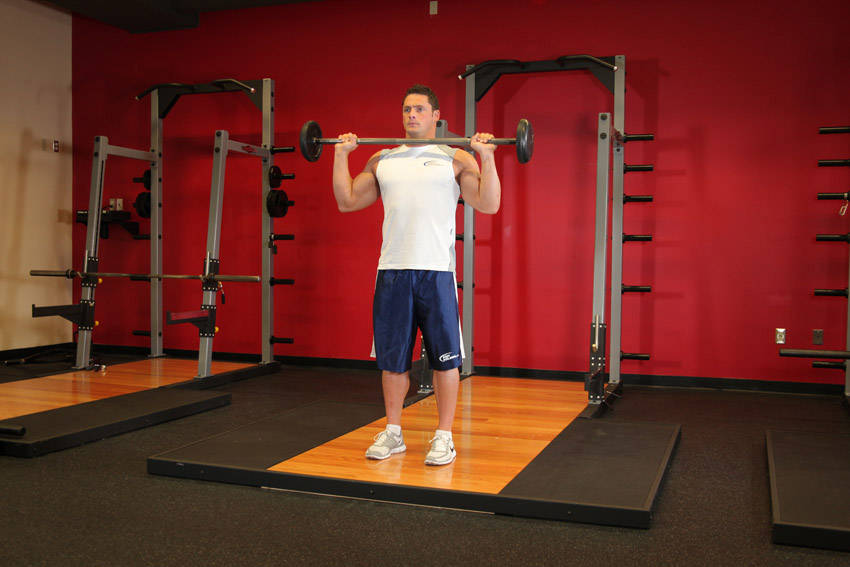
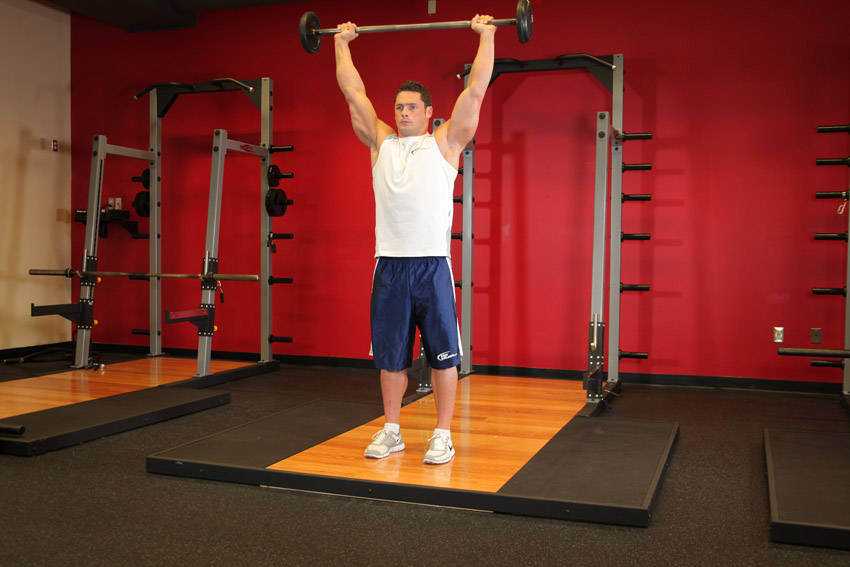
Muscles worked
- Front deltoid (primary)
- Side deltoid
- Triceps
Equipment
Barbell, Dumbbells
How to do it
- Set the bar in a rack at about upper chest height. Grip it just outside your shoulders with your palms facing forward and your wrists stacked over your elbows.
- Lift the bar out of the rack so it rests on your front delts and collarbones, then step back and stand with your feet about hip width apart.
- Keep your elbows slightly in front of the bar. Squeeze your glutes, brace your abs and keep your ribs down.
- Tuck your chin and move your head back slightly so the bar can pass in a straight line in front of your face.
- Press the bar straight up. Once it passes your forehead, move your head forward and under it so the bar ends over your shoulders and mid-foot.
- Finish with your arms straight, without forcing them hard into lockout, and shrug up slightly so your shoulder blades rise with the bar.
- Lower the bar slowly back to your collarbones, moving your head out of the way, then reset your brace before the next rep.
Common mistakes
- Leaning back. A big lean turns the lift into a standing incline press and loads your lower back. Squeeze your glutes hard, keep your ribs down and reduce the load if needed.
- Pressing the bar forward. A bar that arcs around your face is out of balance and feels much heavier. Move your head instead, and keep the bar in a straight vertical line.
- Flaring your elbows. Elbows out to the sides take away your leverage. Start with your forearms vertical and your elbows slightly forward.
- Stopping short of overhead. Finishing with the bar in front of your head leaves your shoulders doing extra work. End each rep with the bar over your mid-foot and your head through.
- Dipping your knees. A little bounce from your legs makes it a push press. That is a fine lift, but keep it separate from your strict sets.
Variations
- Dumbbell shoulder press : Press dumbbells seated or standing when you want each arm to work evenly and a freer path.
- Seated barbell press : Sit on a bench with back support to take your legs and much of your balance out of the lift.
- Push press : Use a short dip and drive from your legs when you want to handle heavier loads and train power.
- Landmine press : Choose it if you want an angled press that needs less overhead range.
Sets and reps to start with
For strength, stay at 3 to 5 sets of 3 to 6 reps and rest 2 to 4 minutes between them. For shoulder size, 3 to 4 sets of 6 to 12 reps with about 2 minutes of rest works well. Beginners can start with 3 sets of 8 on an empty bar, which weighs 20 kg (45 lb) in most gyms, or use lighter dumbbells. Press once or twice a week. This lift progresses slowly, so use small jumps of 1 to 2.5 kg (2.5 to 5 lb) if your gym has the plates. If you stall, stay on the same weight and add reps before you move up.
Frequently asked questions
What muscles does the overhead press work?
It trains your front delts and triceps the most, with your side delts and upper chest assisting. Your upper traps help at the top. Your abs, glutes and lower back work to keep your body steady, especially when you press standing.
Is the overhead press the same as the military press?
In most gyms, the two names mean the same thing. Strictly speaking, the military press traditionally refers to a very strict version done with your heels together. For practical purposes, a standing barbell press with no leg drive fits both names.
Is it better to overhead press standing or seated?
Standing trains more of your body, and seated lets you focus on your shoulders. If your goal is overall strength and stability, stand up. If your goal is mainly shoulder size, or you get tired from balancing, seated pressing with back support works well.
Does the overhead press build side delts?
It trains them to a degree, but your front delts do more of the work. If you want wider-looking shoulders, add lateral raises alongside your pressing. The two together cover more of the shoulder than either one alone.
How much should I be able to overhead press?
There is no universal target, as your build, sex and training history all play a part. Most lifters press much less than they bench, so do not be surprised by small numbers. Aim to beat your own best sets over time.
Similar exercises
Log your overhead press and see the weight to try at every workout. Free, no ads.