Incline Dumbbell Press
The incline dumbbell press is a pressing exercise done on a bench set between flat and upright. The angle puts more of the work on your upper chest, the fibers that run up toward your collarbone, while your triceps and front delts assist. It is one of the most useful chest lifts for anyone trying to fill out the top of the chest, and it is simple enough for beginners who have learned to control a pair of dumbbells.
Next to the incline barbell press, dumbbells let each arm work on its own, so a stronger side cannot quietly carry a weaker one. Your hands are also free to find a comfortable path and can travel a little deeper at the bottom and closer together at the top. You will press less total weight than with a barbell, and you do have to get the dumbbells into position by yourself, which becomes the hard part as the load climbs.
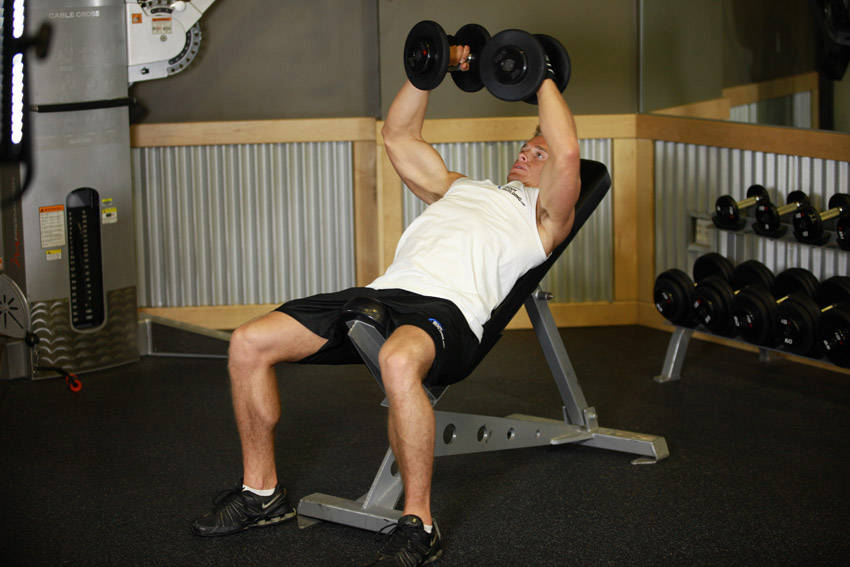
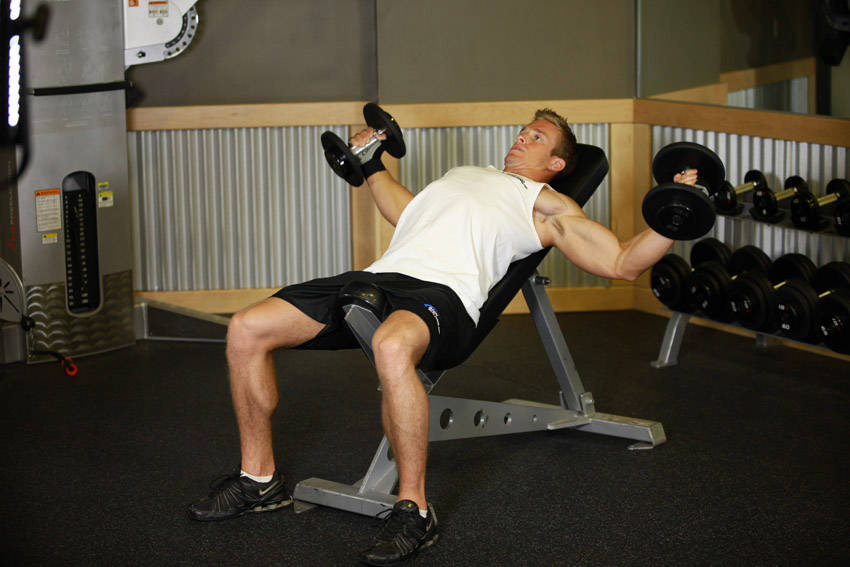
Muscles worked
- Upper chest (primary)
- Triceps
Equipment
Dumbbells
How to do it
- Set the bench to a moderate incline, around 30 to 45 degrees. Sit with your feet flat and rest the dumbbells on your thighs close to your knees.
- Lean back and kick one knee up at a time to help each dumbbell to your shoulders. Press your upper back into the pad and pull your shoulder blades back and down.
- Press the dumbbells up over your upper chest with your palms facing forward or angled slightly in. This is your start position.
- Lower the dumbbells slowly to the sides of your upper chest, with your elbows angled somewhat toward your ribs rather than straight out from your shoulders. Your forearms should stay close to vertical.
- Stop when you feel a good stretch across your chest and the dumbbells are about level with your chest. Stay tight here, with no bounce.
- Press up and slightly inward until your arms are straight, without banging the dumbbells together. Keep your shoulder blades pinned to the bench.
- After your last rep, bring the dumbbells to your thighs as you sit up, or lower them to the floor with control if you are using a heavy pair.
Common mistakes
- Setting the bench too steep. As the bench gets closer to upright, the lift starts to feel like a shoulder press. If your front delts do all the work, lower the bench a notch or two.
- Flaring your elbows straight out. Elbows held out at shoulder height shorten the range and often feel rough on the shoulders. Bring them in slightly so your upper arms make an angle with your torso.
- Losing your shoulder blade position. If your shoulders roll forward at the top, the chest loses tension. Stop each rep at straight arms rather than reaching for the ceiling.
- Cutting the bottom short. Half reps let you use heavier dumbbells, but the stretch is a big part of the benefit. Pick a load you can lower to chest level every rep.
- Arching your way to a flat press. A huge arch lifts your chest and cancels the incline you set up. Keep a small natural arch and your hips on the seat.
Variations
- Low incline dumbbell press : Set the bench one or two notches above flat if steeper angles put too much work on your shoulders.
- Neutral-grip incline dumbbell press : Keep your palms facing each other if that feels better on your shoulders or you want a little more triceps.
- Single-arm incline dumbbell press : Press one side at a time when you want to fix a strength gap and make your core resist twisting.
- Incline barbell bench press : Choose it when your main goal is moving more total weight and you have a rack or a spotter.
Sets and reps to start with
For upper chest size, use 3 to 4 sets of 8 to 12 reps with about 90 seconds to 2 minutes of rest, stopping a rep or two short of failure. For strength, 4 sets of 6 to 8 with heavier dumbbells and longer rests works well, as long as you can still get them into position safely. Beginners can start with 3 sets of 10 and leave a couple of reps in reserve. One or two sessions a week is plenty, and it fits well as the first or second chest lift of the day. Because dumbbells jump in steps of 1 to 2.5 kg (2.5 to 5 lb) per hand, stay on a weight until you hit the top of your rep range on all sets.
Frequently asked questions
What is the best bench angle for the incline dumbbell press?
Around 30 to 45 degrees suits most people. Lower settings stay closer to a flat press, and steeper settings bring in more of your front delts. Gym benches vary, so try a few notches and use the one where you feel your upper chest working the most.
Does the incline dumbbell press work the upper chest?
Yes, the incline puts more emphasis on your upper chest than a flat press does. Your whole chest still works, along with your triceps and front delts. You cannot isolate the upper chest entirely, but you can shift the emphasis toward it.
How do you get heavy dumbbells up for an incline press?
Use your legs. Sit with the dumbbells standing on your thighs near your knees, then lean back and drive one knee up as you rock back, followed by the other. If the weight is too heavy to do that with control, ask someone to hand you the dumbbells or use a lighter pair.
Is the incline dumbbell press better than the incline barbell press?
Neither is strictly better, as they fit different goals. Dumbbells offer more freedom of movement and train each side evenly, while the barbell lets you load heavier and add small amounts of weight. Many lifters use one as a main lift and the other as a change of pace.
Similar exercises
- Incline Bench Press
- Incline Dumbbell Fly
- Incline Chest Press Machine
- Low Cable Fly
- Barbell Bench Press
- Chest Dips
Log your incline dumbbell press and see the weight to try at every workout. Free, no ads.