Cable Crossover
The cable crossover is a chest isolation exercise done between two high pulleys. You stand in the middle, a little in front of the cables, and sweep your hands down and together in a wide arc until they meet or cross in front of your hips. Pulling from high to low puts the emphasis on your lower chest, and your front delts help. It works best as a finisher for lifters who already press and want more direct chest work.
Your presses are limited by your triceps and shoulders, and a dumbbell fly loses most of its tension near the top because the weight sits directly above your shoulders. Cables keep pulling across your body, so your chest stays loaded right up to the point where your arms squeeze together. You can also change the pulley height in seconds to change the angle. The downside is that it is a poor choice for heavy loads, since you will run out of balance before you run out of muscle.
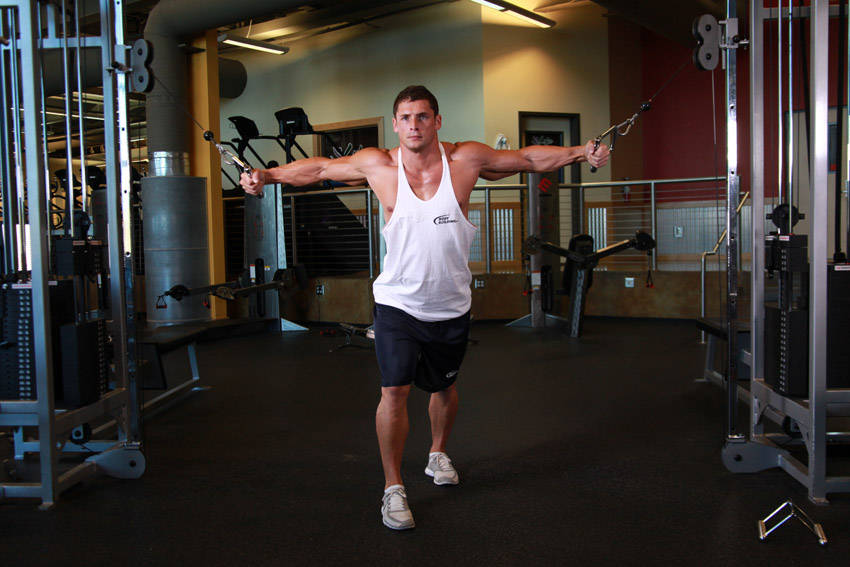
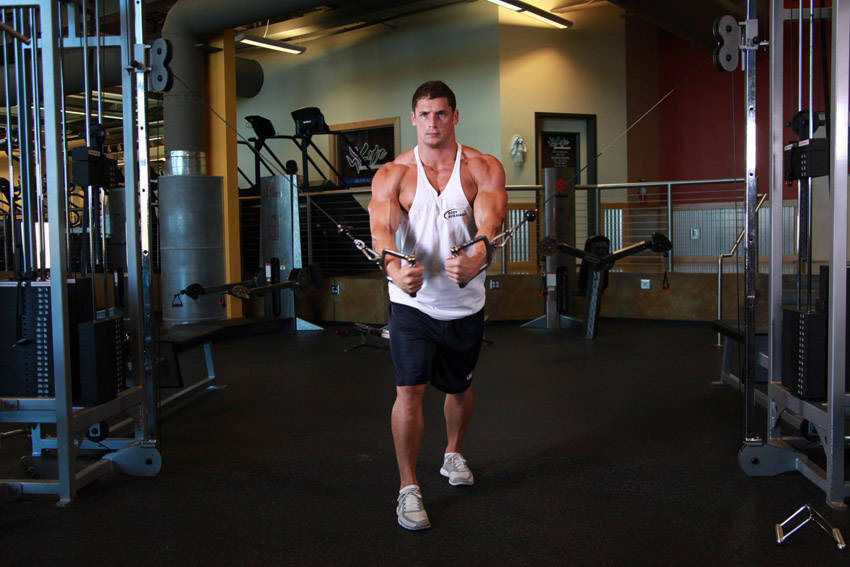
Muscles worked
- Lower chest (primary)
Equipment
Cables
How to do it
- Set both pulleys above head height and attach a single handle to each. Choose the same light load on both sides.
- Take one handle, then the other, and step forward until both cables are slightly behind you. Stagger your feet so you are stable and lean your torso forward a little from your hips.
- Bend your elbows slightly and open your arms out to the sides, with your chest up, until you feel a stretch in your chest without your shoulders rolling forward. This is your start position.
- Keeping the same elbow bend, sweep your hands down and inward in a wide arc, as if hugging a large barrel.
- Bring your hands together in front of your lower chest or hips and let them cross slightly. Squeeze your chest for a second.
- Let your arms travel back along the same arc over two or three seconds, stopping at the same stretch. Alternate which hand crosses on top from rep to rep.
Common mistakes
- Pressing the handles. If your elbows bend and straighten during the rep, it has become a press. Pick a lighter load and hold the same slight bend throughout.
- Stretching too far back. Letting the cables drag your arms well behind your body strains the front of your shoulders and takes tension off your chest. Stop at a comfortable stretch and keep your chest high.
- Pumping your torso. Bowing forward on every rep uses your body weight to move the stack. Set your lean once and hold it for the whole set.
- Shrugging as you pull. Raised shoulders turn the effort toward your traps. Pull your shoulders down before you start, and keep them there.
Variations
- High cable fly : Use the same high pulleys with your hands stopping at chest height when you want a slightly shorter arc.
- Low cable fly : Set the pulleys low and sweep up to shoulder height to emphasize your upper chest instead of the lower fibers.
- Single-arm cable crossover : Train one side at a time so your hand can cross further over your body and you can focus on each rep.
- Cable fly : Set the pulleys around chest height and bring your hands together in front of your sternum for a mid chest focus.
Sets and reps to start with
Program the cable crossover after your main presses, as a way to add chest volume without much fatigue. Use 3 to 4 sets of 10 to 15 reps with 60 to 90 seconds of rest and a short squeeze on each rep. Beginners can start with 2 to 3 sets of 12 to 15 at a load that lets them keep their elbows fixed. Once or twice a week is plenty. Stacks vary a lot between gyms and pulley systems change how heavy a pin setting feels, so compare your numbers on the same station. Progress with reps and a slower return before adding weight.
Frequently asked questions
What does the cable crossover work?
It trains your chest, with the emphasis on the lower fibers when you pull from high pulleys. Your front delts assist. Changing pulley height changes the angle, so low pulleys shift the focus to your upper chest instead.
What is the difference between a cable crossover and a cable fly?
The two names are often used for the same family of exercises. A crossover usually means your hands meet and cross at the end of the rep, often from high pulleys, while a cable fly usually stops with your hands together. The hand cross gives you a little more range at the end.
Should your hands cross on a cable crossover?
Yes, crossing slightly is fine and adds a little extra range to your squeeze. Alternate which hand ends up on top so both sides get the same work. If crossing makes your shoulders roll forward, stop with your hands touching.
Does the cable crossover build the inner chest?
It trains your whole chest, and you cannot target an inner section on its own. Your chest muscle fibers attach at your sternum and your upper arm, so the entire muscle shortens as your arm crosses your body. The strong squeeze at the end is what people feel in the middle of their chest.
Similar exercises
- Chest Dips
- Decline Bench Press
- Decline Chest Press Machine
- High Cable Fly
- Decline Dumbbell Press
- Barbell Bench Press
Log your cable crossover and see the weight to try at every workout. Free, no ads.