Incline Dumbbell Curl
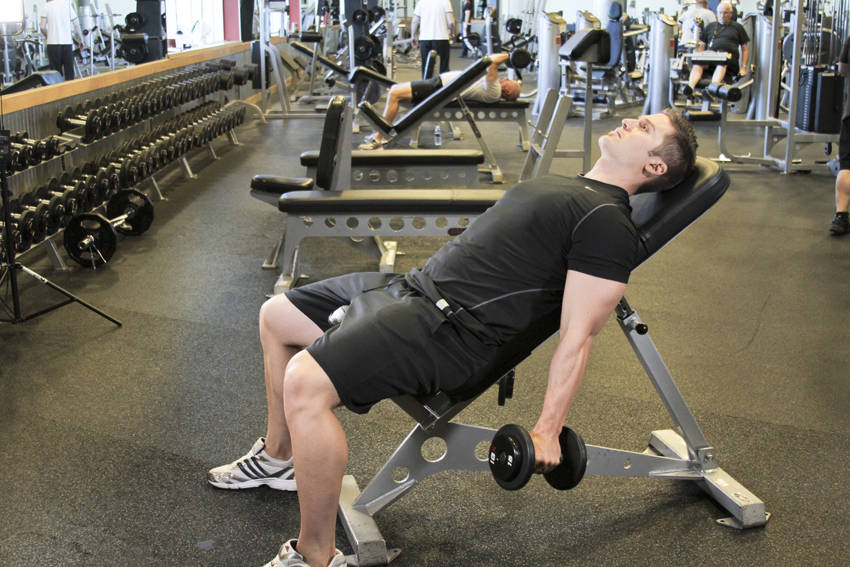
The incline dumbbell curl is a biceps curl done while leaning back on an incline bench, with your arms hanging down behind your torso. That position puts your shoulders behind your body, which stretches the biceps before each rep even starts, particularly the long head that crosses the shoulder joint. It is a great pick for lifters who already curl regularly and want a harder version, and it works for beginners too with light dumbbells.
A standing curl lets you swing your hips and drift your elbows forward, which makes the top of the rep easy. On the incline, the bench blocks your torso and your arms start from a lengthened position, so the bottom half of the curl becomes the tough part. You will use less weight than on a standing curl, often noticeably less. Think of it as a lift that rewards a slow lowering phase more than heavy dumbbells.
Muscles worked
- Biceps (primary)
Equipment
Dumbbells
How to do it
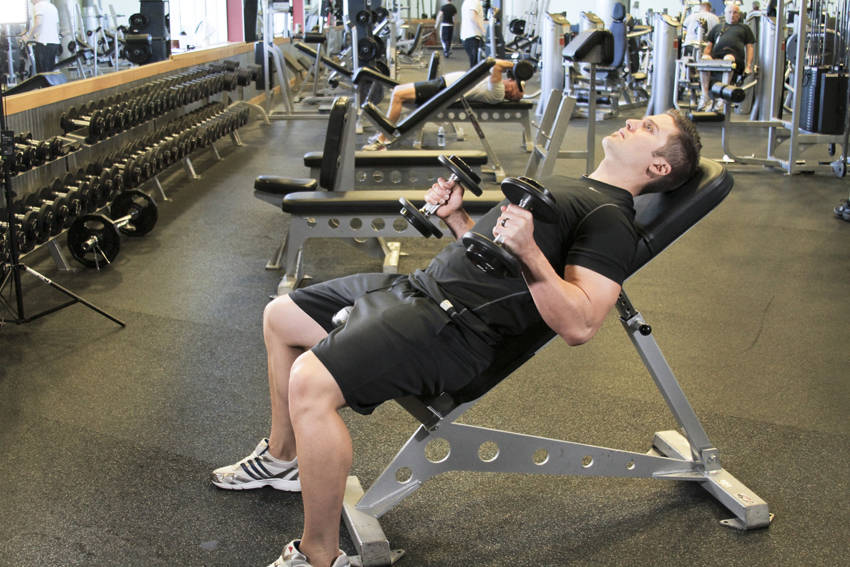
- Set a bench to an incline of around 45 to 60 degrees. Sit back with your head and shoulders on the pad and your feet flat on the floor.
- Let the dumbbells hang straight down from your shoulders, with your arms perpendicular to the floor. Your elbows will sit slightly behind your torso.
- Turn your palms forward, or start with them facing your thighs and rotate them forward as you lift.
- Curl the dumbbells up by bending only at your elbows. Your upper arms stay still and your elbows stay pointing at the floor.
- Stop when your forearms are close to vertical or when your elbows would have to move forward to go higher. Squeeze your biceps for a moment.
- Lower slowly, taking two or three seconds, until your arms are fully straight. Feel the stretch at the bottom, then start the next rep without swinging.
Common mistakes
- Letting your elbows swing forward. Bringing your elbows up as you curl removes the stretch that sets this lift apart. Pick lighter dumbbells and keep your upper arms hanging straight down.
- Rolling your shoulders forward. If your shoulders lift off the pad, you lose the arm position. Keep your shoulder blades against the bench for the whole set.
- Stopping short of straight arms. Half reps skip the part of the movement you came for. Lower until your elbows are straight, and control that last bit.
- Using a bench that is too low. A very low incline can feel like too much on the front of your shoulders. Raise the bench a notch until you get a strong stretch that still feels comfortable.
Variations
- Incline hammer curl : Keep your palms facing each other to bring in more of your brachialis and forearms while keeping the stretched position.
- Alternating incline curl : Curl one arm at a time when you want to focus on each rep and rest the other arm for a moment.
- Spider curl : Lie chest down on the bench when you want the opposite emphasis, with the hardest point at the top of the curl.
- Cable curl : Stand with your back to a low pulley for a similar arm position with more even tension through the rep.
Sets and reps to start with
Use this as a second or third biceps exercise, or as your main curl if your elbows stay put. Aim for 3 sets of 8 to 12 reps with 60 to 90 seconds of rest, taking about three seconds on the way down. Beginners can start with 2 to 3 sets of 12 using dumbbells that feel light at first. Going to failure on the last set is fine here since a missed rep carries little risk. One or two sessions a week is enough alongside your rows and pulldowns. Dumbbell jumps feel large on this lift, so add reps until you reach 12 on every set before you move up.
Frequently asked questions
What angle should the bench be for incline curls?
An incline of about 45 to 60 degrees works for most people. Lower angles stretch the biceps more but ask more of your shoulder mobility. Go with the lowest setting where the front of your shoulders feels comfortable and your elbows can stay still.
Do incline curls work the long head of the biceps?
They train both heads, with extra stretch on the long head. The long head crosses the shoulder, so placing your arm behind your body lengthens it more than a standing curl does. You cannot fully isolate one head, but this is one of the most common picks for emphasizing that stretched position.
Why are incline curls so much harder than regular curls?
You start from a stretched position and the bench stops you from using your body to help. That makes the bottom of each rep hard, and you cannot rely on momentum. It is normal to drop the weight compared with a standing curl.
Are incline curls better than standing curls?
They are better for training biceps in a stretched position, but standing curls let you use more weight. The two complement each other, so many lifters do a heavier standing curl first and incline curls after. If you only have time for one, pick the version you can do with the cleanest form.
Similar exercises
Log your incline dumbbell curl and see the weight to try at every workout. Free, no ads.