Hip Thrust
The hip thrust is a barbell exercise where you rest your upper back on a bench and drive your hips up until your body forms a straight line from knees to shoulders. Your glutes do most of the work, with your hamstrings and quads helping. It is one of the most direct ways to load the glutes heavily, so it is popular with anyone training for glute size, and with athletes who want strong hip extension for sprinting and jumping.
Squats and deadlifts train the glutes hardest when your hips are bent, near the bottom of the rep. The hip thrust does the opposite: resistance peaks when your hips are fully extended at the top, right where a squat gets easy. It also asks little of your lower back and knees compared with those lifts in terms of technique, and it is easy to learn. Setup is the annoying part, since you need a bench, a pad and a bit of floor.
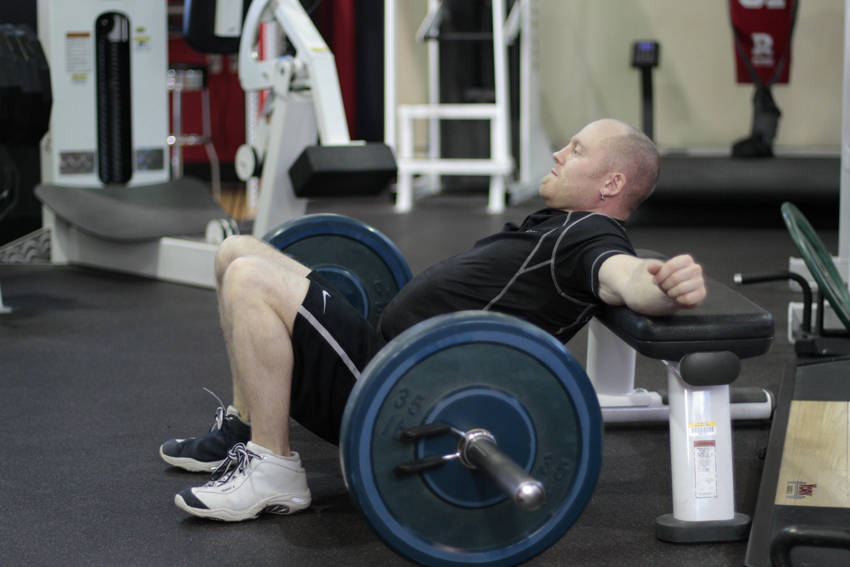
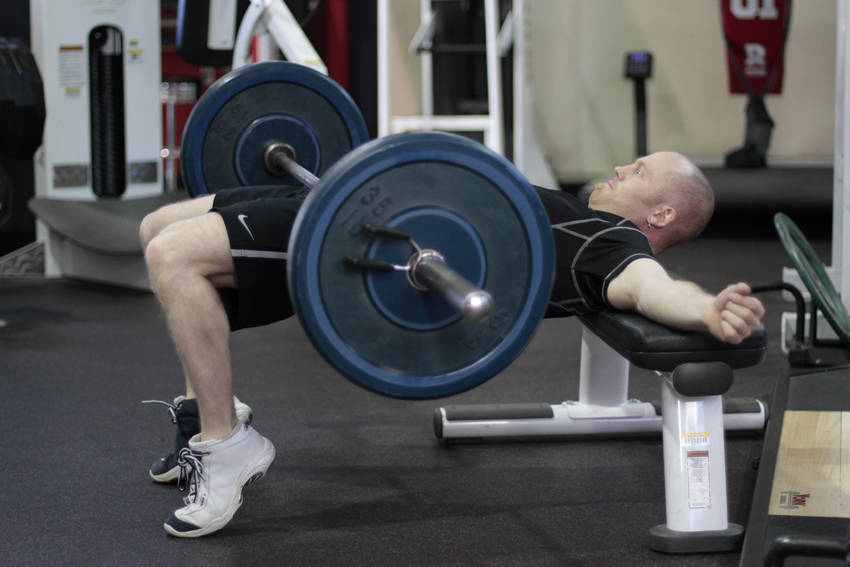
Muscles worked
- Glutes (primary)
Equipment
Barbell
How to do it
- Sit on the floor with a stable bench behind you and the lower edge of your shoulder blades against its edge. Roll a loaded barbell over your legs until it sits in the crease of your hips, with a thick pad around it.
- Plant your feet about shoulder width apart, toes turned slightly out, and bring them close enough that your shins will be vertical at the top.
- Hold the bar with both hands to keep it steady, tuck your chin slightly and brace your abs as if preparing for a light punch.
- Push through your heels and mid-foot and drive your hips straight up. Your upper back pivots on the bench while your eyes stay looking forward rather than at the ceiling.
- Finish with your torso level with the floor and your knees bent to about 90 degrees. Keep your ribs down, tilt your pelvis slightly under and squeeze your glutes hard for a second.
- Lower your hips under control until they are a few inches off the floor or the bar is close to touching, then drive up again without bouncing.
Common mistakes
- Arching your lower back at the top. Extra height from your spine does nothing for your glutes. Stop when your hips are level with your knees and shoulders, and keep your ribs pulled down.
- Placing your feet too far away. Feet set far from the bench shift the work to your hamstrings. Move them in until your shins are vertical at the top of the rep.
- Placing your feet too close. If you feel mostly your quads, or your heels lift, your feet are too near your hips. Slide them out a little and keep pressure in your heels.
- Letting your knees cave in. Keep your knees in line with your toes, pushing them out gently as you rise. If this is hard, take some weight off.
- Rushing the lockout. Bouncing through the top skips the position that makes the lift worthwhile. Hold each rep for a full second before lowering.
Variations
- Glute bridge : Do it from the floor with your shoulders on the ground when you have no bench, or when you want a shorter range and a simpler setup.
- Single-leg hip thrust : Use body weight or a small load to fix a side-to-side difference when heavy barbells are not available.
- Banded hip thrust : Add a band around your knees or across your hips to feel your glutes better and increase tension near the top.
- Hip thrust machine : Choose it when loading a barbell and fitting the pad is the main thing keeping you from training the lift.
Sets and reps to start with
For glute size, do 3 to 4 sets of 8 to 12 reps with about 90 seconds to 2 minutes of rest and a one-second hold at the top. For strength, 4 sets of 5 to 8 with a heavier bar works well, and resting 2 to 3 minutes helps. Beginners can start with body weight or the empty 20 kg (45 lb) bar, then load up gradually with 3 sets of 10 to 12. Train it once or twice a week, usually early in a leg or glute session. Add a small step, about 10% of the bar at most at first and up to 5 kg (10 lb) once it is heavy, when every rep reaches a full lockout with a clean pause, and log your lifts so you can tell real progress from a good day.
Frequently asked questions
Are hip thrusts better than squats for glutes?
They load your glutes more directly at the top of the movement, while squats train them in a deep stretch and also build your quads. Neither replaces the other. If glute size is your main goal, doing both across a week covers the full range.
How do I stop the barbell hurting my hips?
Use a thick pad, and place it right over the crease of your hips. A folded mat or a large foam pad works as well as a branded one, and bigger plates also help by raising the bar. Clothing with a smooth surface can make it slide, so keep your hands on the bar.
Why do I feel hip thrusts in my hamstrings?
Your feet are probably too far from your body. Move them closer until your shins are vertical at the top, and push through your heels without pulling yourself toward your feet. Your hamstrings help a bit on any hip thrust, but your glutes should feel the most work.
How high should the bench be for hip thrusts?
A standard flat bench works for most people, as long as it reaches around the bottom of your shoulder blades when you sit on the floor. Tall lifters are usually fine, and shorter lifters may prefer a lower box or step. Make sure the bench cannot slide by putting it against a wall or a rack.
Should you feel hip thrusts in your lower back?
You should not feel your lower back doing the work. If it is tired, you are likely over-arching at the top, so keep your ribs down and stop at a flat torso. If you feel pain, stop the exercise and see a professional.
Similar exercises
Log your hip thrust and see the weight to try at every workout. Free, no ads.